Upside Down, Still Rooted
by Candace Garlock
April 13, Monday. I woke up feeling a mix of nerves and anticipation, convinced this might be the most challenging collaboration I’ve ever facilitated. As I opened my inbox, an email from The Polyphony caught my attention: “If You Go Down to the Woods Today” by Aly Fixter.
As I read, a sense of awe settled in. It felt like one of those quiet affirmations from the universe—a reminder that I’m on the right path. The piece described the collaboration between Kate Marx and Tracey Falcon, exploring what trees can teach us about movement, history, and shifting identities. Their work echoed so deeply with what we were about to begin.
The forecast had promised cold and rain, but the day unfolded differently. The sun rose, steady and warm, and we found ourselves walking together through the woods at Travelers’ Rest State Park—exactly where we needed to be.
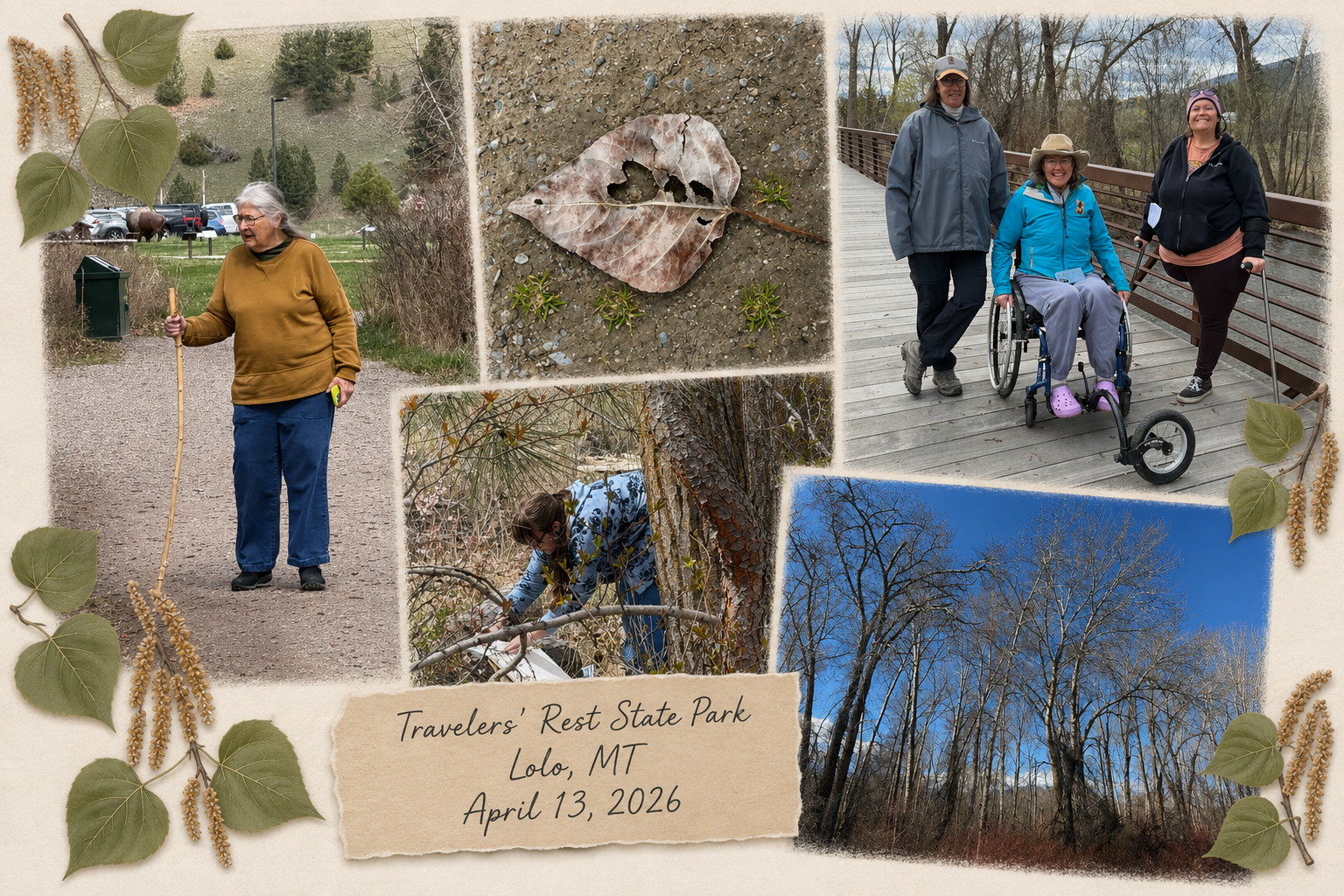
Jean Belangie-Nye, Elaine Fraticelli, Anita Santasier, Lori Messenger, Sherene Ricci
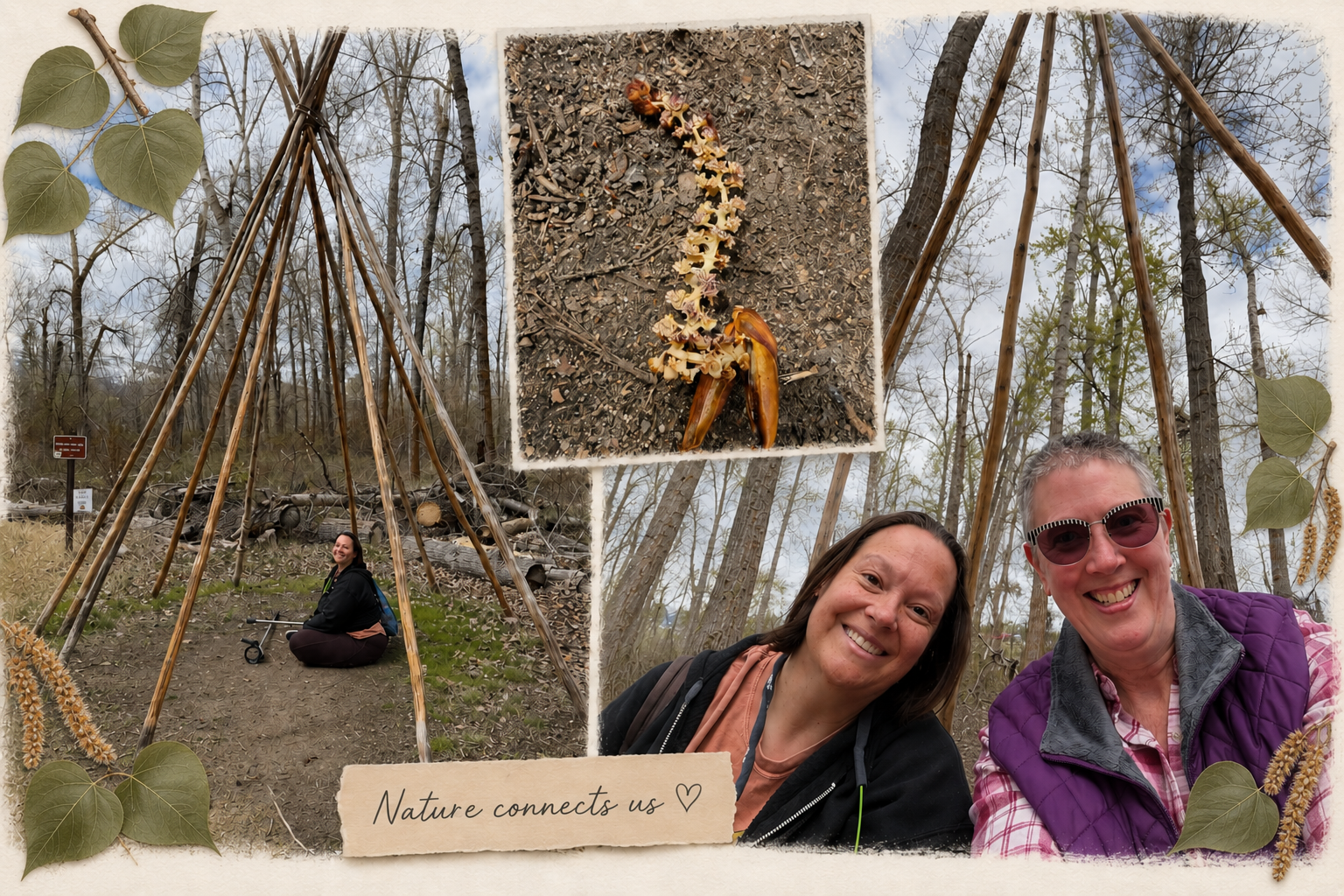
Sherene Ricci, Candace Garlock
Drawing the tree:
Jean - I have a whole series of trees that are faces. They’re not their trunks, and they look… I’ve got one that, if I ever blow it up, is going to be called “Romance,” because it looks like they’re kissing each other.
Candace - Are you going to put one in here?
Jean - I mean, he really is—he’s got legs, and there’s a top, and there’s the face. But this is a good image of what the bark looks like for me.
Elaine - Oh yeah, that’s good. I think I have a good image too. Where is my pencil?
Candace - So is this part getting cut, or we haven’t decided yet? Is this part water, or nothing?
Lori - I suspect it might be nice to cut it more… not linear. Like, curved a little bit, so the way that it’ll drape down, the curve goes backwards.
Candace - Flip your phone—wouldn’t that be nice to have? I want this picture right now.
Jean - I start drawing detail and I don’t know how to stop.
Candace - Just make sure your detail is thick enough so you’re going to have some space. Then what we’re going to carve out will stay white. Think about your image in black and white. You’re going to want to trace all the forms in the bark with the black, and then leave the parts where the wood is—that’s going to be white. And the darker black in the ridges is going to be black.
Susie - Yeah, we’re cutting the white.
LOOKING AT PICTURES IN THIER PHONES.
Candace - I feel like you can edit and turn it into a black-and-white drawing too, can’t you?
Sherene - There are a whole bunch of things, like “Mountain”…
Jean - Yeah, there are ways to do it in Photoshop.
Lori - It’s in the phone. I mean, he really is—
Elaine - There should be a symbol. Isn’t there that conversion symbol?
Sherene - Like, a whole branch in an image is dark color?
Candace - Yes, that’s a positive, and we want that. We want lots of black, a lot of variety of line. And if we do have chunkier parts of black, it allows the eye to travel through it better, whereas the fine lines are fine.
Jean - If you want to look at a picture, they are in the cottonwood—they’re actually very… a little bit…
Anita - Is there a fine-point marker around? This one?
David - No, I cannot believe the fineness on those little prints in there. It’s so crazy.
Elaine - A wood engraving?
Candace - Yeah, it’s a totally different thing. But even then…
Jean - We did a workshop on the kind of tools she used for printmaking. We’re going to do one in a month with the group.
Elaine - OK, let me see. Should I…? Because I’m just trying to get this to repeat.
Lori - Would you like to come out and draw in the middle? And we know that this is putting water right there, so I know how to draw it.
Candace - Well, everybody would love the water. The water is already in here—it’s the wood grain. It’s already here.
Elaine - This is water. This is a trunk.
Jean - OK, the wood grain, like a mushroom?
Candace - Are you putting water all the way up to the bridge?
Elaine - The water doesn’t get up there; it comes all the way down. But let me add…
Susie - So this is water right here, correct?
Day two: carving a woodcut
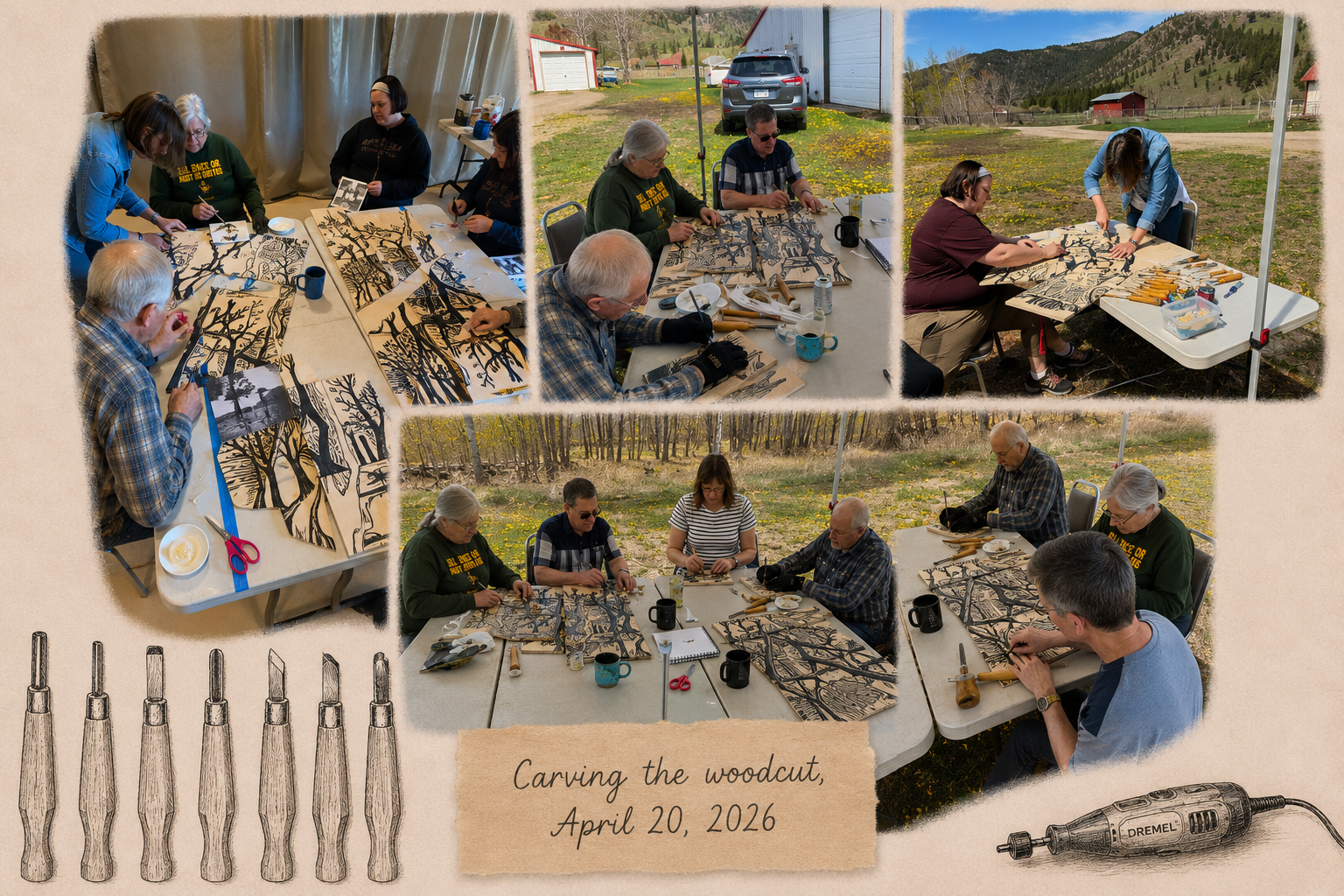
Carving started on April 20th, then continued through the week and April 27th.
Day Three: Casting feet
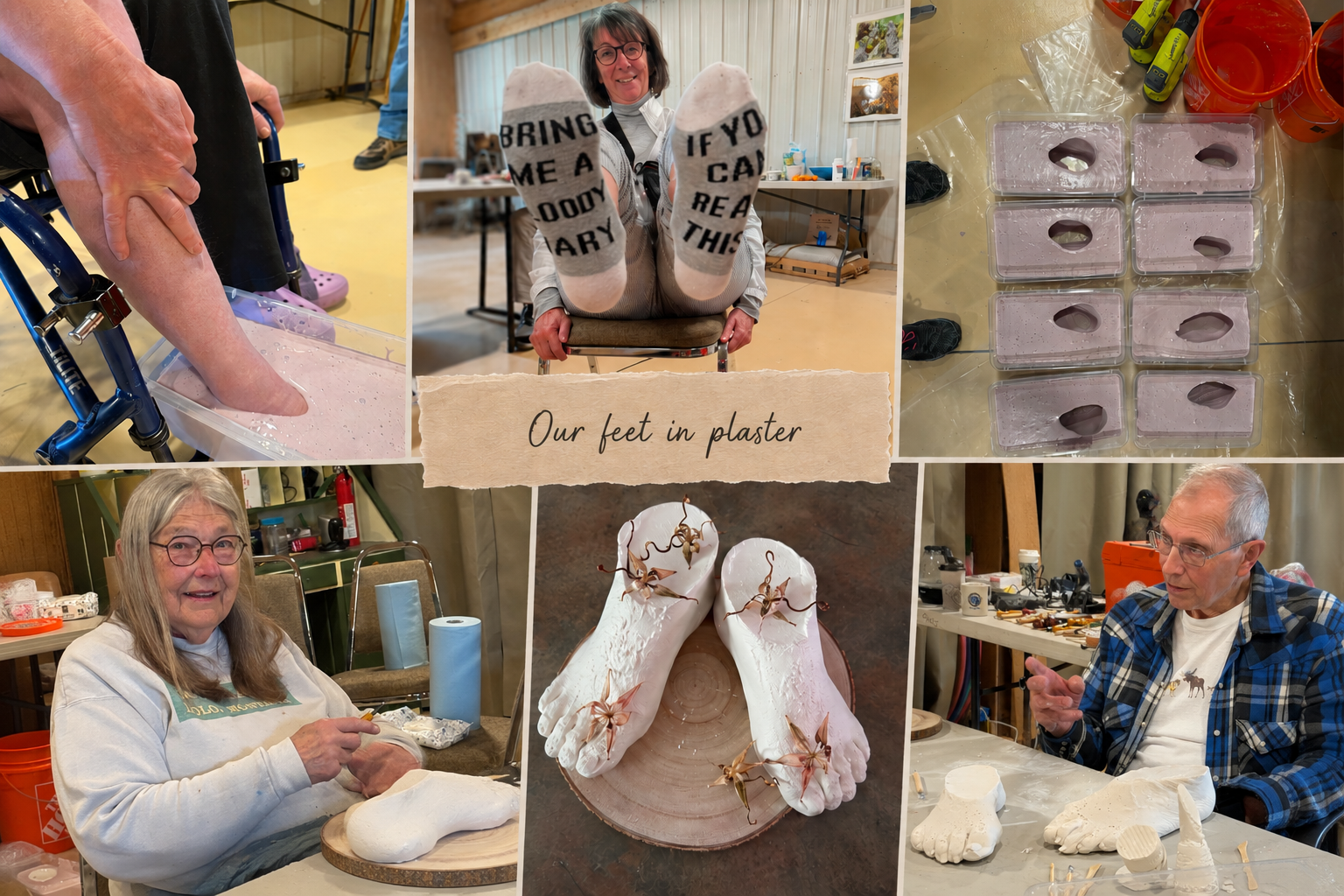
There is a moment—quiet but irreversible—when the body stops translating the world in the way it once did. The ground is still there, the air still moves, the trees still stand, but the signals falter. Sensation becomes uncertain. Balance becomes intentional. What was once automatic becomes something you must watch, measure, and relearn. On April 27th, while removing the alginate from their plaster-cast feet, the Travelers’ Rest/ OpenAIR Cohort reflected on these moments, connecting their experiences with this project.
In these upside moments, the world does not disappear. It tilts.
For humans, our lives are built in motion—walking forest floors, feeling soil through bare feet, carrying the memory of terrain in muscle and skin—and the loss of sensation is not just physical. It is relational. Feet are not simply tools for movement; they are points of contact, translators between body and earth. To lose feeling in them is to lose a language.
Lori shares a bit of her story in this upside down forest: “When I was in the hospital, they very rigorously removed all my calluses because they were worried about skin sores. It was a big deal. You couldn’t have anything that might create pressure or lead to a sore. It was wild for me, because I had spent years working in the woods, wearing boots, going barefoot in my yard and garden. My feet were such a big part of my life. Watching them remove those calluses—constantly applying heavy-duty lotion—made my feet feel exposed, almost naked. They had good reasons. Skin can dry and crack, and that can lead to sores, which they absolutely wanted to avoid. Still, it made me realize how much we rely on our feet, and how vulnerable they are.”
The result was a kind of exposure. Feet that once carried history now felt “naked,” unfamiliar—protected, yet disconnected. Not being able to feel the world through your feet is a really big deal.
This disconnection echoes a deeper neurological truth. Muscles may still move, but without signal, without sensation, the loop between intention and action breaks. The body becomes something you must observe from the outside. You look down to confirm what you can no longer feel. You trust, but verify. You move, but with distance.
This is where the image of the upside-down tree emerges—not just as an artistic choice, but as a lived metaphor.
David tells us, “For me, my feet get really cold when I’m outside. I can’t feel parts of them, especially the left side of my left foot.”
Candace responds, “I, too, have to constantly look down to make sure I’m stepping correctly. I know the muscles are working, but the signals aren’t getting through—my brain isn’t receiving them.”
A tree, rooted and rising, suggests stability. But invert it, and it begins to resemble the human body: roots like neurons, branching networks like veins or lymphatic pathways. What was once grounding becomes exposed. What was hidden becomes visible. The structure remains, but its meaning shifts.
So too with disability. It is not simply loss—it is reorientation, a turning over of systems once taken for granted. The world is not gone; it is rearranged. And yet, beneath this inversion, something persists.
ROOTS
Even when unseen, even when only vaguely understood, they hold the system together. In trees, roots spread wide rather than deep, forming networks that stabilize, nourish, and connect. In the human body, similar networks—neurological, circulatory, sensory—operate largely out of sight, quietly sustaining us. We rarely think about them until something goes wrong.
But once we do, awareness deepens. What was invisible becomes central. What was assumed becomes precious. Candace shares, “For me, that disconnect became part of the reason for this whole project—the upside-down tree, disconnected from the feet. It reflects how signals get disrupted. When you enter the world of disability—whether temporarily or permanently—your whole world turns upside down. A tree normally grows from roots upward, but when you turn it upside down, it starts to resemble the body: like neurons, or the lymphatic system. The roots look like networks inside us. We often don’t pay much attention to our feet. We take them for granted. But when they stop working the way they used to, everything changes.”
Lori responds, “I don’t feel like I ever took that for granted. I grew up as an athlete and an outdoorswoman—movement was always precious to me. But even then, changes came.”
Jean shares, “Circulation issues, injuries, limitations. I was hiking on the L&C Howard Creek Trail, walking backwards on a very steep section and video taping. While talking, I tripped on a tree root. Broke it in 7 places. It was the summer before the Bi-centennial.Even now, returning to those activities, I’m not as strong as I used to be. It’s an ongoing process of rebuilding.”
Elaine responds, “Yeah my ankle is the thing that's the most prevalent but I didn't break it. I was in a car accident, my partner passed away instantly, and I had a stroke due to skull fractures around my carotid arteries. I spent four and half years learning how to walk, run, bicycle, and drive again, so what you say is true for sure. I'm medicated for muscle dystonia which is overactive brain signals, and I also have very low brain signals to my right foot. I can move enough now but the strength still isn't there. Progress plateaus after a couple years and my accident was 9 years ago, so it will be a lifelong journey to stay strong, which is definitely something I took for granted.
To live in this altered state is not to abandon the past, but to renegotiate it. Strength may not return in the same form. Movement may be slower, more deliberate. But attention sharpens. Meaning accumulates in small acts: a step taken carefully, a surface felt faintly, a system understood more fully.
Near the end of the gathering, Anita points out that we didn’t draw the roots. She says, “It makes you think about grounding—about systems. Like a tree: what we see above ground is only part of it. The root system underground is just as large, just as important. When we drew the trees, we focused on what we could see—the trunk and branches. The roots were more abstract because we don’t really see them. We know cottonwoods, for example, don’t root deeply—they spread out wide instead. There’s so much happening beneath the surface, in both trees and bodies.”
The world may be upside down.
But the roots are still there—spreading, adapting, holding.
Travelers’ Rest State Park (@travelersrestconnection) hosted a gathering of creatives at a site rich with layered history—where Native travelers, the Bitterroot Salish, and the Lewis and Clark Expedition once camped along Lolo Creek. As the only archaeologically verified Lewis and Clark campsite in the nation, it offered a powerful intersection of cultural heritage and Montana’s natural landscape.
This collaboration was made possible through OpenAIR (@openairmt), whose place-based artist-in-residence program connected artists with meaningful sites across Montana. Together, participants engaged with the land’s history, listened to its stories, and explored new creative work.
Participants included:
Jean Belangie-Nye (facebook)
Candace Garlock (@candacegarlock)
Sherene Ricci
David Dobrowski
Lori Messenger
Susie Elliott (@morningstarsusie)
Anita Santasier
Elaine Fraticelli (@elainefraticelliart)