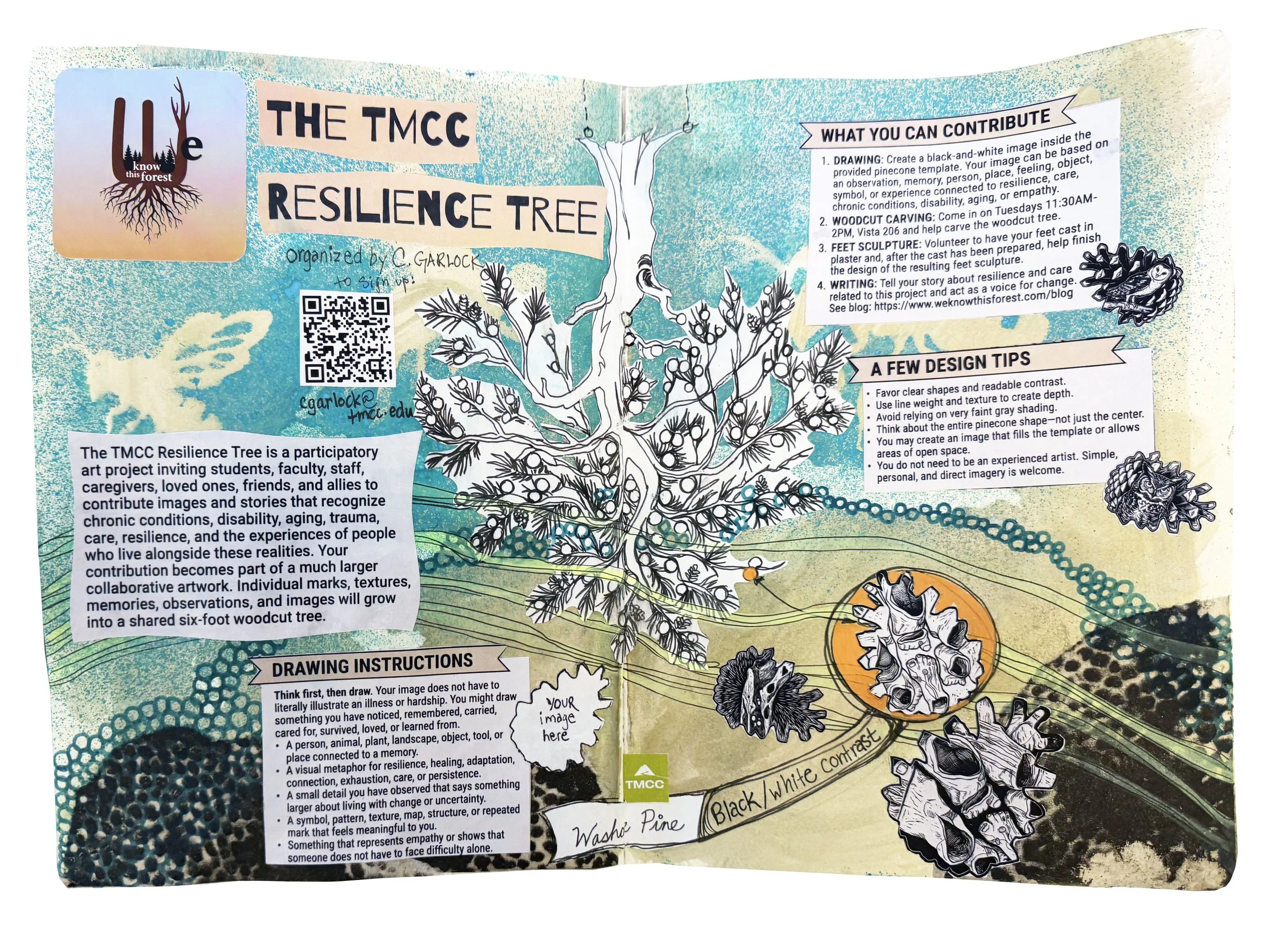
Instruction handout
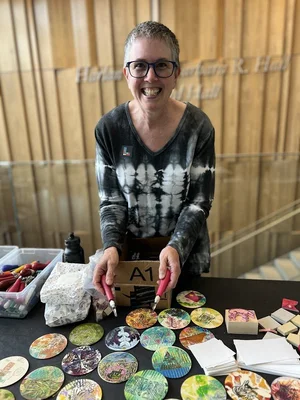
On August 17, we gathered to introduce the TMCC Resilience Tree: a growing community artwork about vulnerability, persistence, care, and the many ways we continue living when our bodies or circumstances change.
At the center of the project is an upside-down pine tree woodcut, built from individual black-and-white pine cone drawings contributed by students, faculty, staff, families, and community members. Participants can also create plaster-cast foot sculptures and contribute poems, stories, reflections, and lived experiences.
The upside-down tree is a metaphor for what it can feel like to navigate chronic illness, disability, caregiving, grief, or periods of uncertainty. It is rooted in the acceptance that we may feel disoriented, rooted in unfamiliar ground, or deep in a forest without a clear path out. But it is also a way of recognizing that resilience is not solitary. It is made through connection, imagination, shared labor, and the willingness to witness one another.
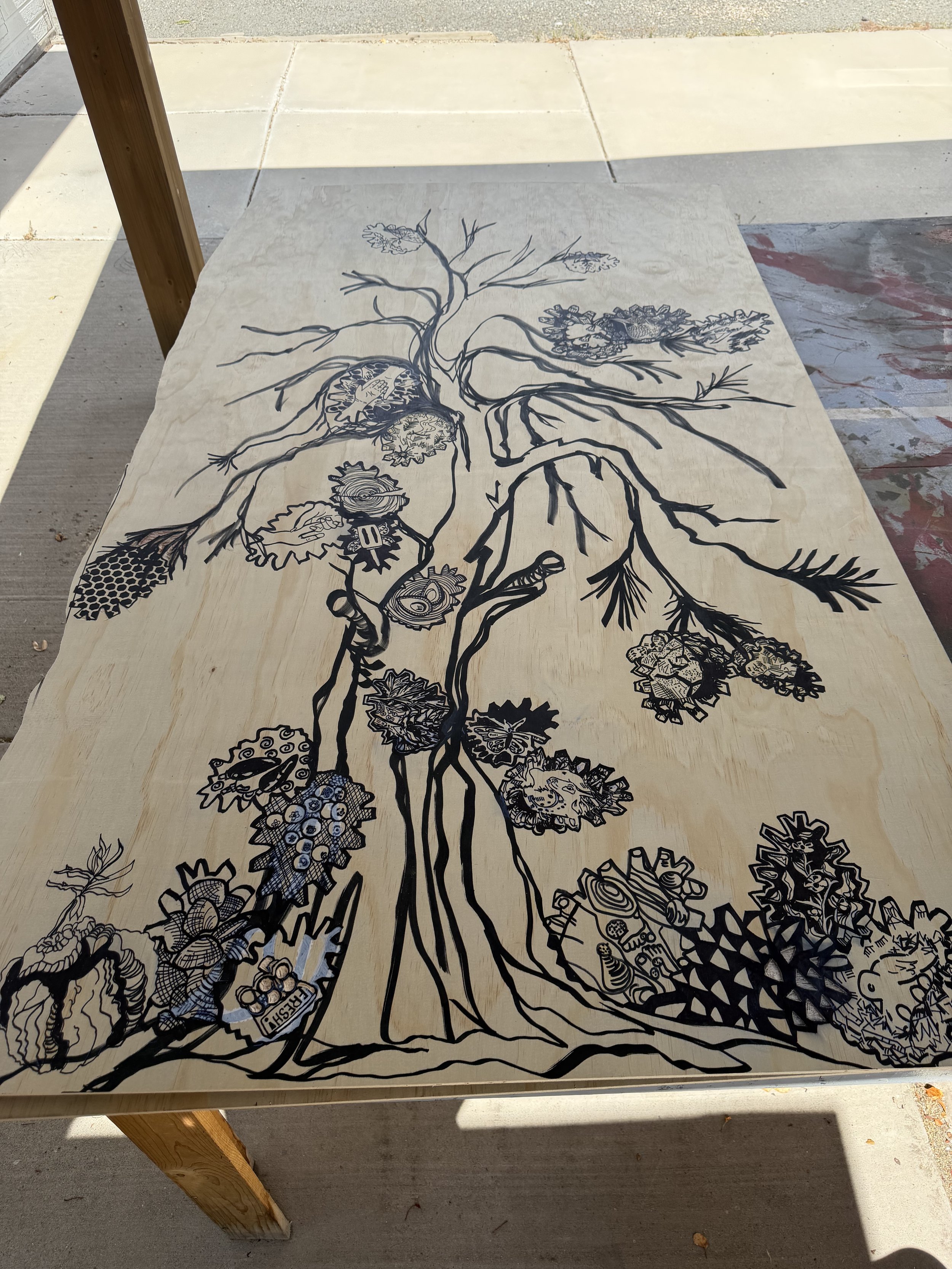
In progress: September 7, 2026
Students and faculty have been adding their pinecone drawings to the tree, meeting in Vista 206 on Tuesdays.
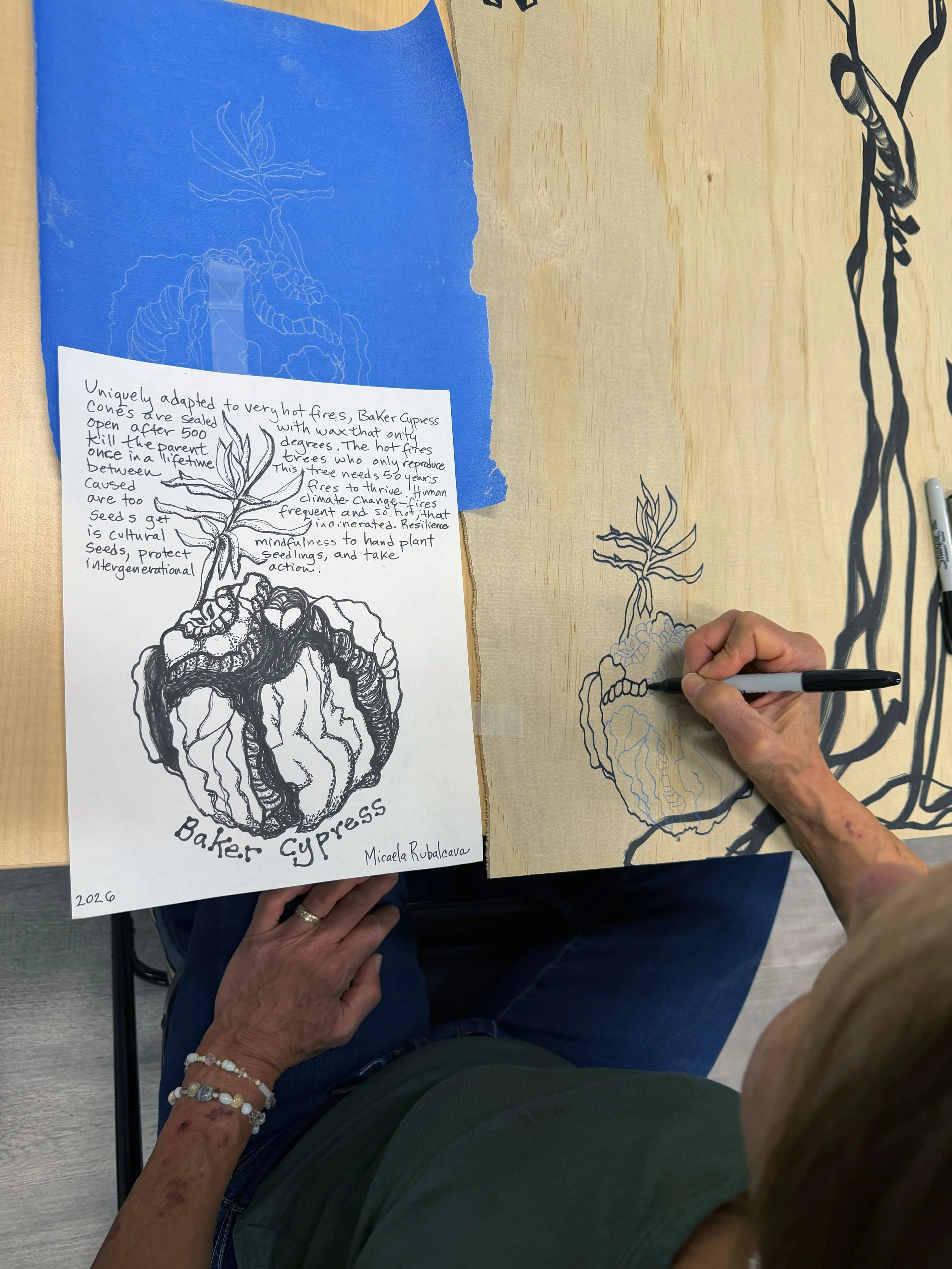
Micaela Rubalcava drawing her Baker Cypress, September 1, 2026
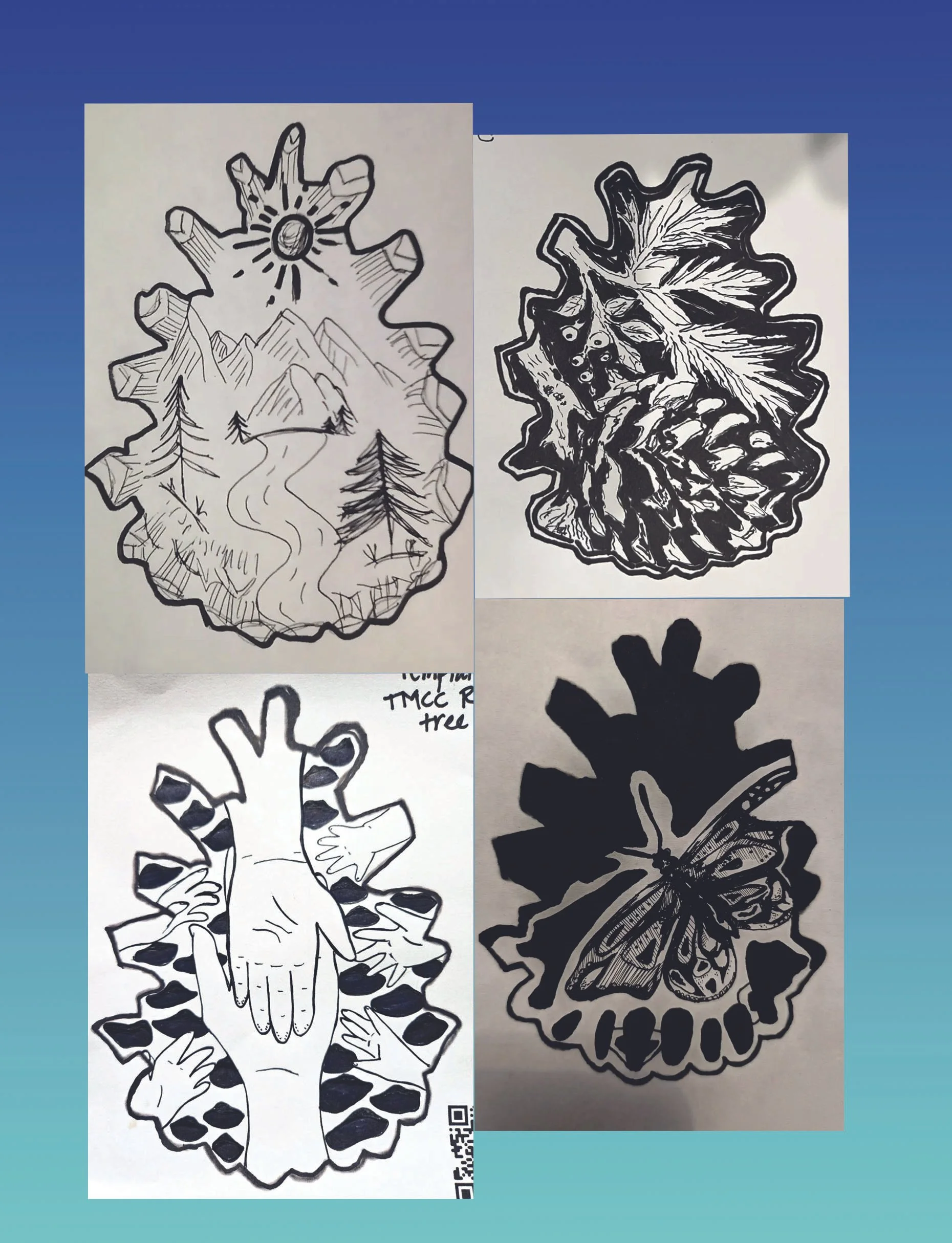
A few of the first pinecone drawings that were drawn onto the tree. Participants above: Zoe Lum, Mohammad Mateen, Taylor Williams, Isabella.
Stories:
In the pinecone there is a mountain with a river and trees. The mountain can represent challenges and goals, while the river can represent how life keeps moving forward. The trees can represent strength and staying grounded. I think this connects to resilience because nature continues to grow and change even when things get difficult. - Zoe Lum
My drawing is based on a pinecone, pine branches, leaves, and berries. The pinecone represents growth and new beginnings because it carries seeds that can grow into new trees. The branches represent connection and support, reminding me that during difficult times, we depend on family, friends, and our community. I chose nature because it continues to grow and adapt even through difficult conditions. This connects to the project’s message of resilience, care, support, and moving forward through change. - Mohammad Mateen
For the We Know This Forest drawing prompt, I chose to focus on what it is like to be the mother of a child with a medical disability, while also being the mother of another child without a medical disability. In 2025 my oldest daughter, who was 6 at the time, was diagnosed with Type 1 Diabetes, which is an autoimmune disease that requires me to manually monitor my daughter's blood sugar levels, administer insulin injections for every meal and any time her blood sugar goes too high, and be vigilant to prevent or treat low blood sugar. I keep my daughter alive by functioning as her mom and her pancreas 24/7. The drawing depicts an adult's hand, with a child's placed on top palm-up (I drew this while imagining the countless times I have to stop the world to check her blood sugar, everything must wait until I see these numbers). The other smaller, reaching hands represent my youngest daughter, now 4 years old, who often has to fight for attention. This was supposed to somehow convey the stress and heartbreak of navigating this type of family dynamic, though I was not exactly sure how to portray this in my drawing. -Taylor Williams
This piece of a butterfly represents Crohn's disease, Crohn's is a chronic disability that has no cure and no cause, it is an autoimmune disease that attacks the digestive system. I have Crohn's, I got diagnosed when I was 15 during my junior year of high school. I think that more people need to be aware of this disease because it's affecting about 1 in 200-300 people and still no cure or solution has been found. I have to deal with this for the rest of my life, physically and mentally. Butterflies are a symbol of transformation, endurance and freedom from the physical limits that come with chronic illness. This art piece shows a butterfly surrounded by blobs and holes to represent the never-ending black hole of struggle that Crohn's causes. The butterfly is being surrounded to show this, but the butterfly is there to show resilience and strength to show people that you are not consumed by your disability, and it doesn't make you who you are. Everyone is beautiful just like this butterfly. - Isabella
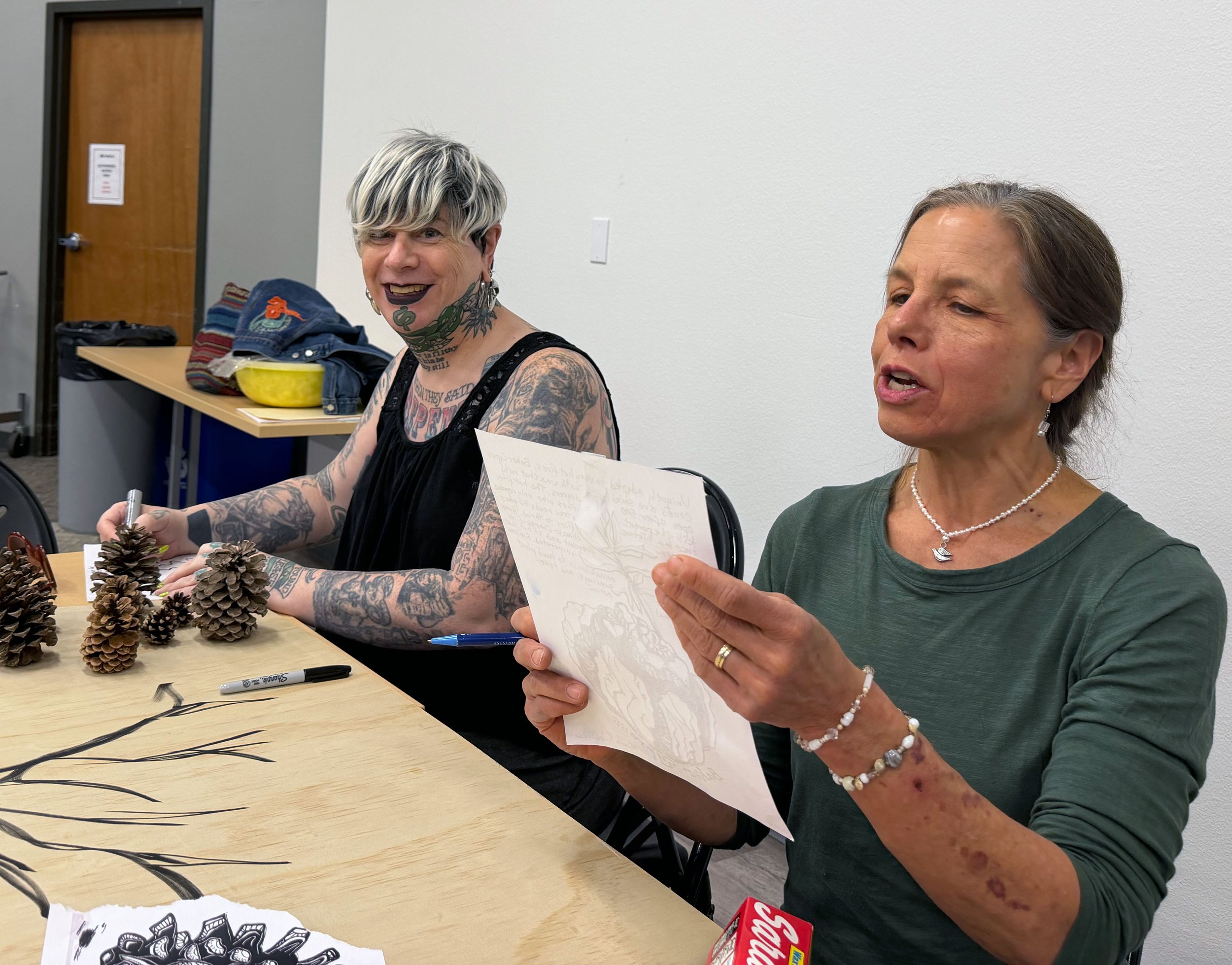
Felixity Danger and Micaela Rubalcava