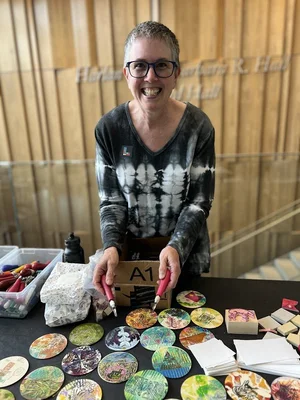
Our First Cohort's Black Cottonwood Woodcut
by Candace Garlock
Video showing the printing of the woodcut from Travelers’ Rest Cohort.
There is a particular kind of quiet that settles over a group of people the moment they carve a woodblock for the first time. That quiet found us this spring at Travelers' Rest State Park, where "We Know This Forest" welcomed its very first cohort of participants — a group of curious, generous makers gathered on the only archaeologically verified Lewis and Clark campsite in the nation, along a stretch of Lolo Creek that centuries of Native travelers, including the Bitterroot Salish, have called home long before it had a name on any map.
We are deeply grateful to Open AIR, whose place-based artist-in-residence program made this collaboration possible and connected our project with a site that already holds so much layered history. Working here meant our woodcut couldn't just be about the forest — it had to come from this particular ground.
For this cohort, the trees we chose to carve were the black cottonwoods standing sentinel along the creek running through the park, the ones whose shade we worked in and whose seed-fluff drifted across our paths. Cutting the block by hand, then rolling it with ink and pulling the first print, is always the moment a project like this stops being an idea and becomes something you can hold.
We Know This Forest asks participants to design and carve woodcut panels as part of a larger, shared installation — prints that will eventually hang suspended overhead, a canopy built from many hands, paired with cast plaster feet grounded below. Every panel a cohort carves becomes part of that forest. This cottonwood panel is now part of ours.
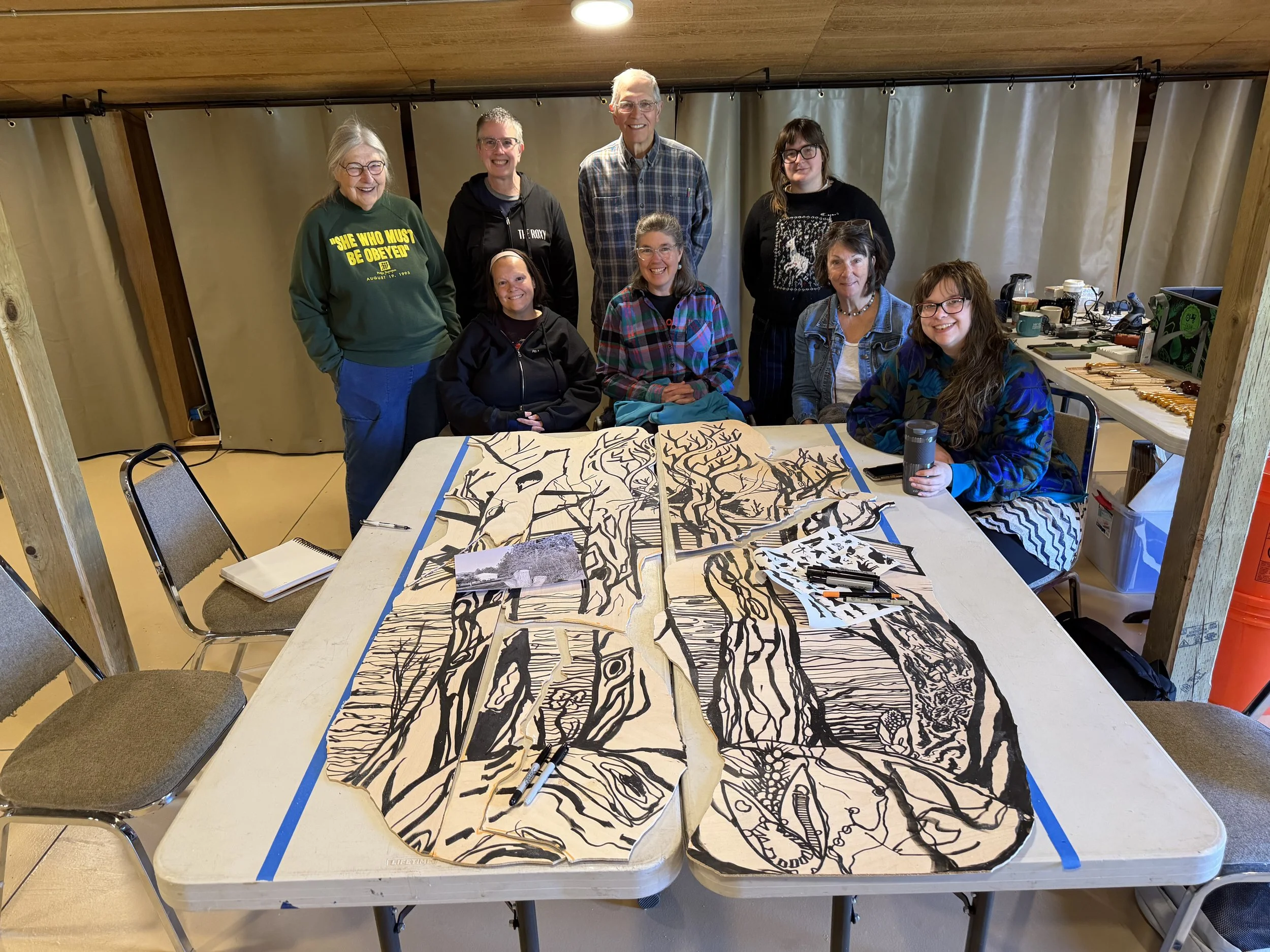
Travelers’ Rest State Park, April 20, 2026: Back Row: Jean Belangie-Nye, Candace Garlock, David Dobrowski, Susie Elliott Front Row: Sherene Ricci, Lori Messenger, Anita Santasier, Elaine Fraticelli
The print cut and suspended upside down above one of the feet sculptures. Shown in Candace Garlock Studio, July 2026
What the Black Cottonwood Taught Us
Printing the tree meant getting to know it first. Between carving sessions, I filled a page in my sketchbook with everything I could learn about Populus balsamifera ssp. trichocarpa — the black cottonwood — much of it drawn from an article in the Montana Naturalist (Fall/Winter 2025 issue) that I carried with me on this trip.
A few things that stayed with me:
It's a giant hiding in the willow family. Cottonwoods belong to Salicaceae, the willow family, and black cottonwoods can grow past 100 feet tall with trunks spanning up to 6 feet in diameter — heart-shaped leaves, rough dark bark, and flowers called catkins.
It needs water to exist at all. Cottonwoods live along streams and rivers and simply don't grow out on the open prairie unless there's a source of water nearby. Their seeds, millions of them, carried on that cotton-like fluff, need very specific floodplain conditions to germinate, which is exactly why they scatter so many: the odds for any single seed are slim.
It survives by more than one method. Beyond seeding, cottonwoods reproduce by suckering. New trees simply rising from the roots of old ones. A grove can be one organism's family tree as much as a forest of individuals, quietly interdependent below the surface.
It carries real weight in Blackfeet history and language, including as a named, storied tree in Blackfeet cosmology and, more painfully, as a site tied to the boarding school era, when cottonwood groves at missions on the Blackfeet Reservation became places where children were punished for speaking their own language. That history sits uneasily and importantly alongside the tree's role as a sacred, living icon.
Learning this made the woodcut meaniful in the best way. This isn't just a nice tree by a creek, it's a living record of water, survival, memory, and harm, all at once. That's the kind of complexity “We Know This Forest” is built to hold: growth and decay, resilience and loss, existing in the same trunk.
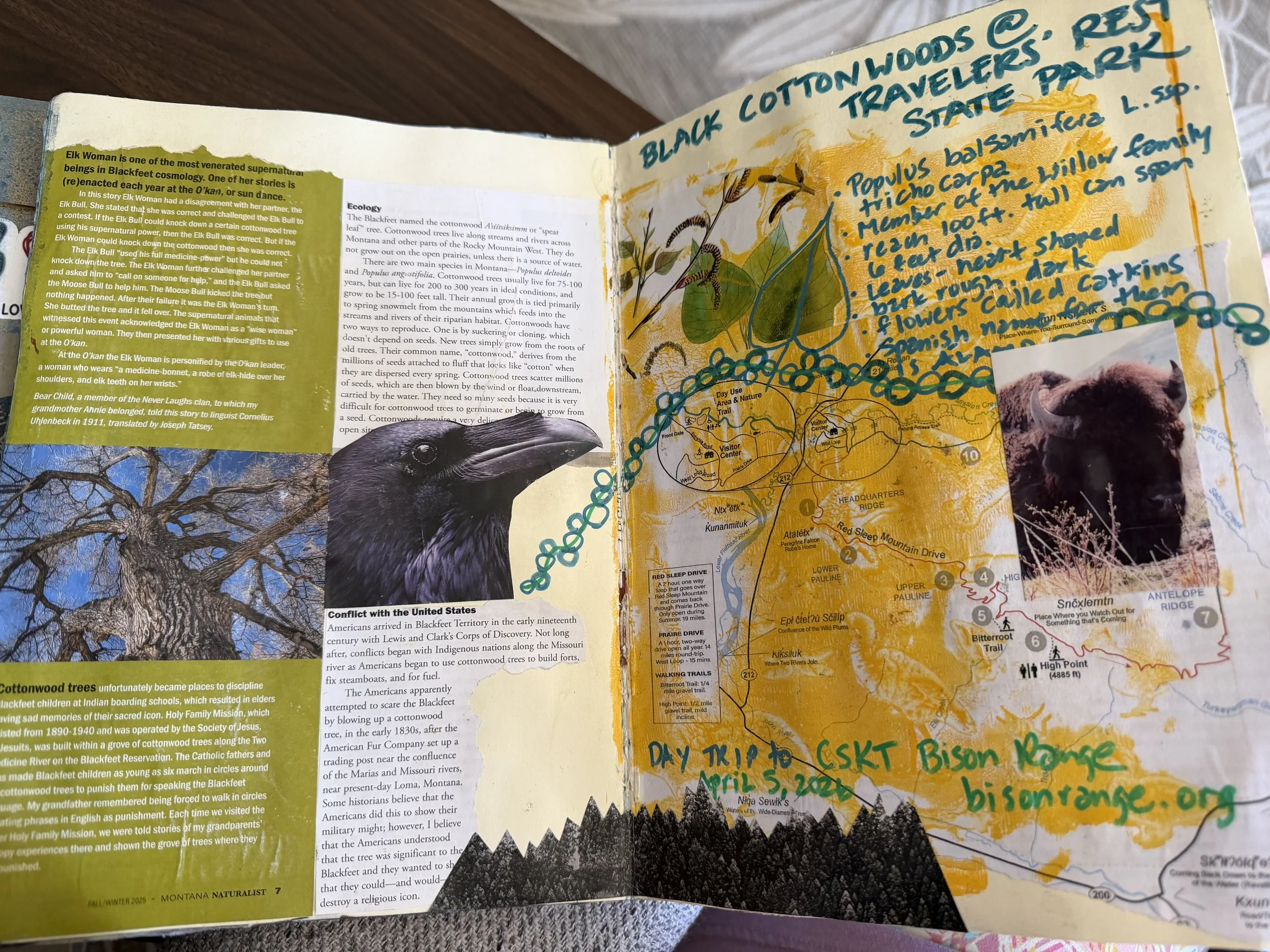
Sketchbook page, Candace Garlock, April 2026
From Sketchbook to Woodblock
That research lives, messily and honestly, in my own sketchbook there are pressed leaves, a raven cut from a magazine, a hand-drawn map, notes in green marker circling back on themselves the way cottonwood roots do. I like sharing these pages alongside the finished prints because the finished woodcut only tells you what we decided to keep. The sketchbook shows the whole tangle it came from: the false starts, the facts that didn't make the cut, the questions I'm still sitting with about who gets to tell a tree's story and how.
Thank You, Travelers' Rest
To our first cohort: thank you for carving alongside me, for asking good questions about a tree most of us had walked past a hundred times without really seeing. To Open AIR: thank you for the invitation to root this project in a place with so much to teach in. And to the black cottonwoods of Lolo Creek- thank you for standing there, water-bound and stubborn and complicated, long enough for us to learn a little of your story and add it to ours.
More cohorts, more panels, more forest to come.
"We Know This Forest" is a participatory community art project by Candace Garlock exploring chronic illness, disability, and lived experience through the metaphor of the forest. Participants carve woodcut panels and cast their own feet to build a shared, immersive installation.